Items Arevaci people
Do you want to take a photo with the camera or select an existing image?
(en) The Arevaci or Aravaci (Arevakos, Arvatkos, or Areukas) were a Celtic people who settled in the central Meseta of northern Hispania and dominated most of Celtiberia from the 4th to late 2nd centuries BC. The Vaccaei were their allies. The Greeks and Romans regarded the Arevaci as the most militaristic people of the eastern Meseta. The Arevaci embarked early on an expansionist policy by taking part in the Celtici migrations of the 5th century BC to settle in the Iberian southwest. In the late 4th and early 3rd centuries BC, the Arevaci shifted the direction of their expansion to the east, towards the upper Duero and south into the central Iberian mountains. Here, they displaced the earlier inhabitants, the Pellendones people, conquering the towns of Savia and Numantia and submitted the Uraci, thus gaining control over the strategic towns of Aregrada, Cortona, Segontia, and Arcobriga. In around the mid-3rd century BC, the Arevaci founded with their neighbours the Lusones, Belli, and Titii, a tribal federation designated the Celtiberian confederacy, with Numantia as its capital. During the Second Punic War, the confederacy kept itself neutral, though Celtiberian mercenaries are mentioned fighting for both sides on a number of occasions. The first Roman incursion into the Celtiberian heartland occurred around 195 BC under Consul Cato the Elder, who attacked unsuccessfully the towns of Seguntia Celtiberorum and Numantia.The Arevaci and the Belli revolted against Roman rule in the Celtiberian War. With the fall of Numantia in 134-133 BC, the Romans forcibly disbanded the Celtiberian confederacy and allowed the Pellendones and Uraci to regain their independence from the Arevaci, who were now technically submitted and absorbed into Hispania Citerior province. Nevertheless, the remaining Arevacian cities managed to keep much of their military capabilities intact, and led by Clunia and Termantia they helped defending Celtiberia from invasion attempts by both the Lusitani in 114 BC and the Cimbri, who poured from the Pyrenees around 104-103 BC. Emboldened by these successes – and resented by the lack of Roman recognition for their efforts – the Arevaci began secretly hatching plots against Roman rule by stirring up their equally disgruntled Celtiberian neighbours into the 99-81 BC uprisings, also known as the Third Celtiberian War. However, not only were the Arevacians ruthlessly repressedd by Proconsul Titus Didius in 92 BC, but also had to endure the destruction of their new capital, Termantia.
External links: Wikidata (Q2527467), Wikipedia [BG], [CA], [DE], [EN], [EO], [ES], [EU], [FA], [FR], [GL], [IT], [NL], [PT], [RU], [UK] 
Arevaci people:
- Arekorata, City of
- Arkailikos gens
- Borneskon
- Kaisesa
- Kolounioku, City of
- Louitiskos
- Lutia, City of
- Sekobirikes
- Sekotias Lakas
- Teitiakos gens
- Uxama Argaela, City of
Iberia (ancient) › Celtiberia › Arevaci people › Arekorata, City of • Unit (158-133 BC)


 As
As (150 BC - 120 BC)
Coins › Standard circulation coins
Brąz • 11.2 g
ACIP# 1751, CNH# 272/15, GCV# 35, Heiss# 7, N# 336464
Iberia (ancient) › Celtiberia › Arevaci people › Arekorata, City of • Denarius (late 2nd century BC)
1 Denarius = 2 Quinarii = 10 Asses • 1 As = 2 Semisses = 4 Quadrantes = 6 Sextantes

 ½ Unit
 (125 BC - 101 BC)
Coins › Standard circulation coins
Brąz • 6.6 g • ⌀ 21 mm
ACIP# 1781, CNH# –, N# 314216

 Unit
Unit (120 BC - 90 BC)
Coins › Standard circulation coins
Brąz • 9 g • ⌀ 23 mm
ACIP# 1777, CNH# 274/29, Vives# 40/12, FAB# 116, N# 327941

 Denarius
 (120 BC - 90 BC)
Coins › Standard circulation coins
Srebro • 3.94 g
ACIP# 1773, CNH# 274/26, Heiss# 1, GCV# 34, N# 336335
Iberia (ancient) › Celtiberia › Arevaci people › Arkailikos gens • Unit (last third of the 2nd century BC)

 Unit
Unit (133 BC - 101 BC)
Coins › Standard circulation coins
Brąz • 11 g • ⌀ 25 mm
ACIP# 1810, CNH# 280/1, N# 316426
Iberia (ancient) › Celtiberia › Arevaci people › Borneskon • Unit (late 2nd century BC)

 Unit
Unit (125 BC - 101 BC)
Coins › Standard circulation coins
Brąz • 9.8 g • ⌀ 25 mm
ACIP# 1586, CNH# 241/3, N# 316423
Iberia (ancient) › Celtiberia › Arevaci people › Kaisesa • Unit (second half of the 2nd century BC)
1 Denarius = 2 Quinarii = 10 Asses • 1 As = 2 Semisses = 4 Quadrantes = 6 Sextantes

 Unit
Unit (150 BC - 101 BC)
Coins › Standard circulation coins
Brąz • 11.5 g • ⌀ 24.5 mm
ACIP# 1819, CNH# 282/1, N# 316421
Iberia (ancient) › Celtiberia › Arevaci people › Kolounioku, City of • Denarius (1st century BC)
1 Denarius = 2 Quinarii = 10 Asses • 1 As = 2 Semisses = 4 Quadrantes = 6 Sextantes

 Unit
Unit (100 BC - 1 BC)
Coins › Standard circulation coins
Brąz • 12.6 g • ⌀ 26.5 mm
ACIP# 1825, CNH# –, N# 316418
Iberia (ancient) › Celtiberia › Arevaci people › Louitiskos • Unit (mid 2nd century BC)

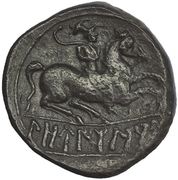 Unit
Unit (166 BC - 134 BC)
Coins › Standard circulation coins
Brąz • 14.5 g • ⌀ 27.5 mm
ACIP# 1787, CNH# 275/1, N# 316416
Iberia (ancient) › Celtiberia › Arevaci people › Lutia, City of • Unit (early 1st century BC)

 Unit
Unit (100 BC - 76 BC)
Coins › Standard circulation coins
Brąz • 8.3 g • ⌀ 22 mm
ACIP# 1600, CNH# 244/1, N# 316440
Iberia (ancient) › Celtiberia › Arevaci people › Sekobirikes • Denarius (late 2nd and early 1st century BC)
1 Denarius = 2 Quinarii = 10 Asses • 1 As = 2 Semisses = 4 Quadrantes = 6 Sextantes

 Denarius
 (110 BC - 80 BC)
Coins › Standard circulation coins
Srebro • 3.96 g
ACIP# 1869, CNH# 292/5, GCV# 38, Heiss# 1, N# 336578

 Denarius
 (110 BC - 80 BC)
Coins › Standard circulation coins
Srebro • 3.53 g • ⌀ 19 mm
ACIP# 1873, CNH# 292/9, N# 382203


 Unit
Unit (110 BC - 80 BC)
Coins › Standard circulation coins
Brąz • 10 g • ⌀ 25 mm
ACIP# 1876, CNH# 291/1, N# 336637
Iberia (ancient) › Celtiberia › Arevaci people › Sekotias Lakas • Unit (last third of the 2nd century BC)

 Unit
Unit (133 BC - 101 BC)
Coins › Standard circulation coins
Brąz • 10.7 g • ⌀ 25.5 mm
ACIP# 1880, CNH# 293/1, N# 316415
Iberia (ancient) › Celtiberia › Arevaci people › Teitiakos gens • Unit (early 1st century BC)

 Unit
Unit (100 BC - 76 BC)
Coins › Standard circulation coins
Brąz • 7.9 g • ⌀ 22 mm
ACIP# 1886, CNH# 294/3, N# 316412
Iberia (ancient) › Celtiberia › Arevaci people › Uxama Argaela, City of • Unit (second half of the 2nd century BC)

 Unit
Unit (150 BC - 101 BC)
Coins › Standard circulation coins
Brąz • 9.4 g • ⌀ 22 mm
ACIP# 1929, CNH# 300/4, N# 316305
Numista referees for this issuer:
Brakuje obiektu w katalogu? Dodaj go samodzielnie! (in English)