Contemporary forgery is a topic that fascinates me and many others. It'd be interesting to see some examples of contemporary counterfeits if you have want to share them. Threads like this have been tried in the past and they have gotten great responses.
I'll start with these George III forgeries:
A 1820 shilling and a 1818 halfcrown. The 1818 halfcrown was faked in such quantity that there is even a warning in the Spink catalogue to watch out for them.
1836 William IV Halfcrown:
It doesn't come through in the photo, but some traces of the original silver coating are still visible on the coin.
Cant wait to see what everyone has. I'll put up some of my other contemporary counterfeits in the morning.
I have 2 contemporary counterfeits of Brazil, both from the 1st Reign period (D. Pedro I ruling period, 1822-1830).
One is a 80 réis of 1821 (mintmark B ) that I've posted here on last year, when this topic was near unknown to me. It's a very clear fake, later I've found out that copper counterfeits were common during the 1820's, specially on some provinces (Bahia for example).
The other is a better copy of a 20 réis of 1829 (mintmark R), good enough to fool me at first sight (no photos sorry); I've found out that it was a contemporary fake only at home. Counterfeiting was more common in the interior, and I suppose that fakes were rare in the capital; that's why I got myself surprised when I've found out that my coin from Rio (capital at the time) was a counterfeit.
I recently got a few, so perfect timing for this thread.
From Choucas, comes this copper (I think) counterfeit of a Sikh Empire rupee dated 1806 AD; this also gave me a new issuer, although I'm more interested in having a rupee- this one will do for now. Silver wash is coming off, and there's a punchmark on the reverse that suggests it was uncovered as a fake by a merchant.
From a Greek member in a swap; a contemporary counterfeit 5 Drachmai from Crete in lead or tin. Particularly interesting since the real type only circulated for less than 20 years, so I'm guessing even as a counterfeit this isn't something you see every day!
I also have a few smaller pieces, like a Suecava counterfeit of a Swedish Livonian solidus, and a 1946 25 satang in zinc/tin, but don't have pictures of those right now.
2015 - United Kingdom - 2 Pounds - Mary Rose
Made out of one piece of metal then coloured to give the appearance
of being bimetallic. Also on obverse is wrong lettering and the portrait is re-designed.
But mainly this coin was issued in 2011 and not the 2015 on the counterfeit. https://en.numista.com/catalogue/pieces17100.html
Also I have some of the old £1 coins that are counterfeit. Including this one ...
Quote: "Giobruno"I have 2 contemporary counterfeits of Brazil, both from the 1st Reign period (D. Pedro I ruling period, 1822-1830).
One is a 80 réis of 1821 (mintmark B ) that I've posted here on last year, when this topic was near unknown to me. It's a very clear fake, later I've found out that copper counterfeits were common during the 1820's, specially on some provinces (Bahia for example).
The other is a better copy of a 20 réis of 1829 (mintmark R), good enough to fool me at first sight (no photos sorry); I've found out that it was a contemporary fake only at home. Counterfeiting was more common in the interior, and I suppose that fakes were rare in the capital; that's why I got myself surprised when I've found out that my coin from Rio (capital at the time) was a counterfeit.
I really like the massive Portuguese and early Imperial Brazil copper coins. I have a few, but I am yet to come across a known fake. I do have one that is considerably overweight. I assumed it was fake, but it turns out that its not uncommon for them to be above weight, I also cant imagine that it would make sense for a forger to invest more metal than they had to into a counterfeit. I suppose they are a bit like those large Elizabeth and Catherine II 5 Kopecks, its not uncommon to find overweight ones.
I've struggled to find info on these Brazilian coins in English, so I know next to nothing about them outside of what the Krause catalogue says. Do you know if they were designed to contain an amount of copper that was as close to their face value as possible, as was the case with the UK's 1797 cartwheel 1d and 2d?
Quote: "ZacUK"2015 - United Kingdom - 2 Pounds - Mary Rose
Made out of one piece of metal then coloured to give the appearance
of being bimetallic. Also on obverse is wrong lettering and the portrait is re-designed.
But mainly this coin was issued in 2011 and not the 2015 on the counterfeit.
https://en.numista.com/catalogue/pieces17100.html
Also I have some of the old £1 coins that are counterfeit. Including this one ...
These are fascinating. All the counterfeits that I've pulled out of circulation in the UK seem to be simple casts of actual coins. It looks like these have been designed from the ground-up. I've never come across anything like them.
Counterfeit Scottish Francis (Dauphin of France) & Mary (Queen of Scots) Hardhead.
Fake on the left, real on the right.
Even the official issues of these coins were extremely crude, this made them a tempting target for forgers. The big giveaway on this fake is the dodgy looking dolphin to the right of the 'FM' monogram. The monogram is a tad wonky on this fake, but I've seen this feature on some real ones. There is also a clear line separating the fake's legend from the centre of the coin. Interestingly this design feature rarely appears on originals, but it is extremely common on the fakes. Most of the fakes in the National Museum of Scotland show this. I suppose they would have acted as guidelines for the comparatively inexpert engravers that made them.
You can see that the real one on the right has a heart and star countermark on its reverse. Forgery of these issues was such an issue that it was ordered, in 1575, that all Mary placks and hardheads be submitted to the mint for inspection. The real ones were to be countermarked with a heart and star stamp (this was a badge of the Earl of Morton, who was regent of Scotland at the time). The exclusion of a countermark doesn't necessarily identify a coin as a fake. The only mint was in Edinburgh, so I cant imagine it would have been possible for most people outside of the capital to make the journey to Edinburgh to verify their coins. Some surviving fakes were even countermarked, showing they fooled those that were best equipped to spot them.
This is my oldest contemporary counterfeit and my only Scottish one. I'm preparing a blog post for the Hunterian Museum that will feature a few Mary, Queen of Scots, contemporary counterfeits. Some of them are pretty brazen. I'll link it here when it goes up.
Quote: "CassTaylor"I recently got a few, so perfect timing for this thread.
From Choucas, comes this copper (I think) counterfeit of a Sikh Empire rupee dated 1806 AD; this also gave me a new issuer, although I'm more interested in having a rupee- this one will do for now. Silver wash is coming off, and there's a punchmark on the reverse that suggests it was uncovered as a fake by a merchant.
Do you think it could have acted as some sort of cancellation mark?
Quote: "cmaclean"I really like the massive Portuguese and early Imperial Brazil copper coins. I have a few, but I am yet to come across a known fake. I do have one that is considerably overweight. I assumed it was fake, but it turns out that its not uncommon for them to be above weight, I also cant imagine that it would make sense for a forger to invest more metal than they had to into a counterfeit. I suppose they are a bit like those large Elizabeth and Catherine II 5 Kopecks, its not uncommon to find overweight ones.
I've struggled to find info on these Brazilian coins in English, so I know next to nothing about them outside of what the Krause catalogue says. Do you know if they were designed to contain an amount of copper that was as close to their face value as possible, as was the case with the UK's 1797 cartwheel 1d and 2d?
That I don't know.
What I know is that copper counterfeiting has gone wild in the provinces during the 1820's due to the economical crisis on that period, which made the fabrication of fake coppers a profitable activity before the coinage reform of 1835.
I know a good text about these fakes, but you'll have to use a translator: https://brasilmoedas.com.br/artigos/#moedas-falsas (same link I've posted last year)
Quote: "Giobruno"That I don't know.
What I know is that copper counterfeiting has gone wild in the provinces during the 1820's due to the economical crisis on that period, which made the fabrication of fake coppers a profitable activity before the coinage reform of 1835.
I know a good text about these fakes, but you'll have to use a translator: https://brasilmoedas.com.br/artigos/#moedas-falsas (same link I've posted last year)
Quote: "CassTaylor"I recently got a few, so perfect timing for this thread.
From Choucas, comes this copper (I think) counterfeit of a Sikh Empire rupee dated 1806 AD; this also gave me a new issuer, although I'm more interested in having a rupee- this one will do for now. Silver wash is coming off, and there's a punchmark on the reverse that suggests it was uncovered as a fake by a merchant.
Do you think it could have acted as some sort of cancellation mark?
Quite possibly, yeah!
I imagine when it was made, the dark copper colour of the coin revealed by the punch would have been a lot more contrasted to the intact silver wash than it is now that the silver is coming off, some 200 years later.
3 highly collectible and valuable U.S coin counterfeits and one inexplicable low value counterfeit I found in a coin return of a vending machine. Why anybody would go to the trouble of faking a modern U.S. quarter, I just cant explain.
Quote: "harryg"3 highly collectible and valuable U.S coin counterfeits and one inexplicable low value counterfeit I found in a coin return of a vending machine. Why anybody would go to the trouble of faking a modern U.S. quarter, I just cant explain.
Interesting. What is the date on the fake quarter? I cant tell if its 1935, 1985 or 1995.
I believe 1985 but its very damaged and hard to be certain. Even at a 1935, it would be silver and worth about $2.75 U.S. In any case, not worth the trouble. Not only a worthless counterfeit but a very bad one at that.
I'd say that the 1985 quarter has spent a long time in an environment which was hostile to copper (ammonia > sewers?), so that it was 'eaten' from the edges inwards, while the copper-nickel plating of the face sides protected the copper core.
Quick question about this one (the fake trade dollar), how can you tell that it's an old fake as opposed to a modern one made to fool collectors?
I really did not bother to make a determination of whether it was a old or more recent counterfeit. This one was about 7g off the proper weight so it was an easy catch from the start.
Quote: "ArnoV"I'd say that the 1985 quarter has spent a long time in an environment which was hostile to copper (ammonia > sewers?), so that it was 'eaten' from the edges inwards, while the copper-nickel plating of the face sides protected the copper core.
No need to presume it's a fake.
Certainly a possibility but in my 62 years, I have never seen anything quite like it.
French West Africa. Counterfeit on the left, real on the right. Appears to be caste of a cheap white metal. I don't know where I got it, most likely a junk box or something.
I don't know if the counterfeit shown below is comtemporary but it fits to this thread and is a good example for beginners to see and realize the difference between original (left: 28.25 g, non magnetic) and (modern chinese?) counterfeit-production (right: 17.81 g, magnetic).
Second picture - edge: original above, counterfeit below.
Quote: "harryg"3 highly collectible and valuable U.S coin counterfeits and one inexplicable low value counterfeit I found in a coin return of a vending machine. Why anybody would go to the trouble of faking a modern U.S. quarter, I just cant explain.
I don't think that the penny and quarter are fake, the quarter is just rusted on the exterior and the copper may be corroded.
This is listed as a "Gloria Excercitvs" nummus of Constantinus II in my collection, but several friends I've shown it to, who specialise in Roman coins say it's likely a barbarian imitation - the retrograde lettering seems to be the red flag.
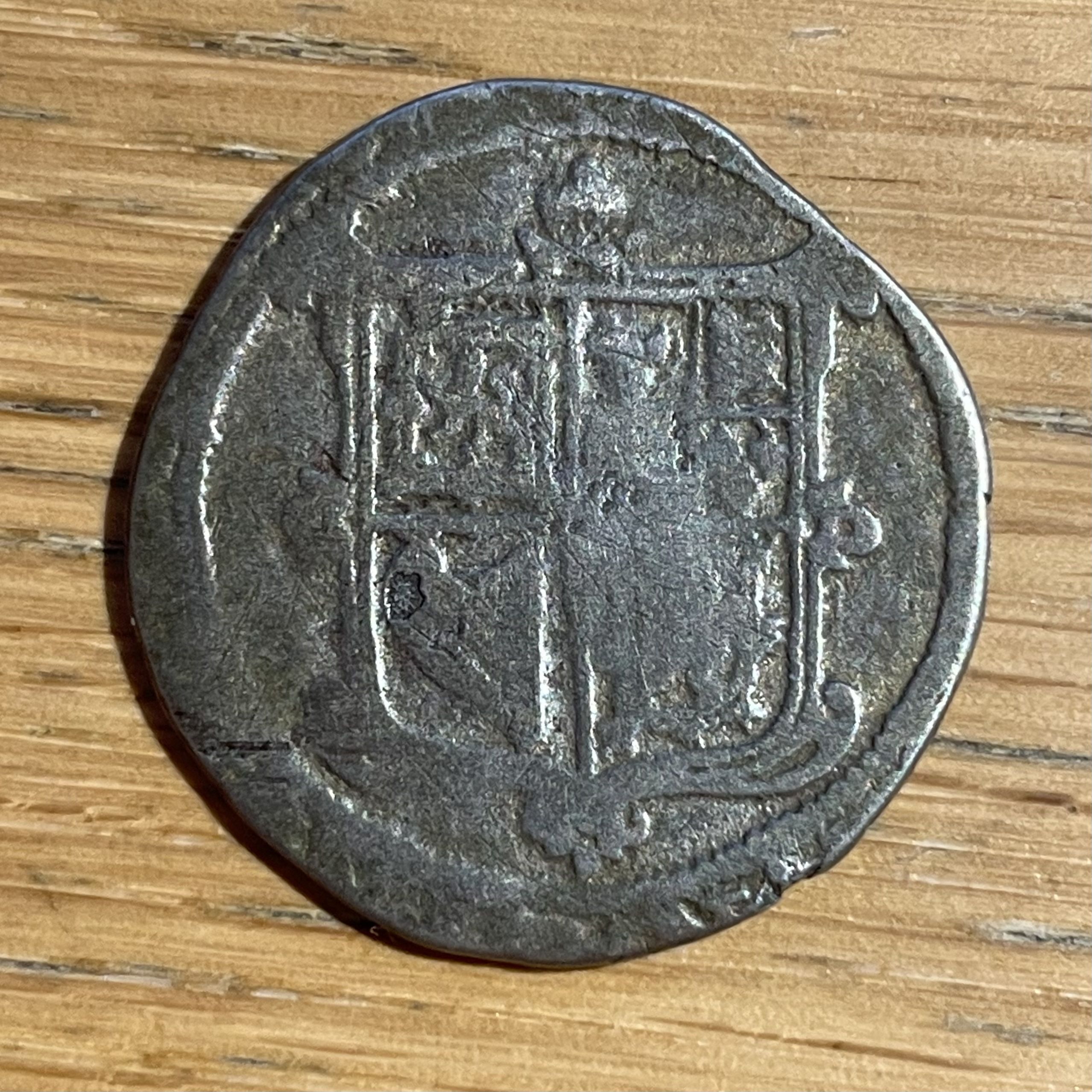
I'll go back to George III (who seems to be popular in this thread) with this, I assume it was silver plated originally.
The reverse looks like it has been worn down deliberately.
Met up with a friend today who gave this to me for free with our swap; it came back from his submission to PCGS as a counterfeit:
The fake is on the right, compared with my real one on the left- an interesting fake of a pre-Meiji issue. The much less sophisticated lettering on the fake and lack of edge markings give it away.
Now up for swap if any collectors of fakes would like it.
Quote: "Harris79"I'll go back to George III (who seems to be popular in this thread) with this, I assume it was silver plated originally.
The reverse looks like it has been worn down deliberately.
Forgery was rife during his reign, especially of the various emergency coinages that were brought in during the Napoleonic Wars. The Hunterian Museum in Glasgow actually has more contemporary counterfeits of George III Bank of England tokens and countermarked dollars in its collection than real ones.
Here are my BofE 3 shilling tokens.
The hole in the coin on the left might have been created to confirm it is a fake or to cancel its circulation. I've read about fake coin being sheared in half or pierced through the centre, but I'm not sure what was used in this period.
The given examples give a pretty good idea of the varying range of quality that can be expected from contemporary counterfeits. This post is just concerned with low denomination hardheads. Part II will deal with higher denomination counterfeits, including what I believe may be the only surviving fake of one of these: https://en.numista.com/catalogue/pieces88485.html
Lebanon 1936 25 Piasteres
counterfeit on the left, real one on the right.
besides the silver color rubbing off to reveal the bronze inside, the counterfeit is 0,55 gram under weight and oddly, about 0,5 mm small in diameter.
It clearly circulated for a long time.
Jamais l'or n'a perdu la plus petite occasion de se montrer stupide. -Balzac
Philippines 1881 50 centavos. 1 on the left is a forgery. Weighs 11 grams. Circumference is the same. A friend of mine gave me this yesterday.
Heavy filing on edge. Not sure of its composition. A magnet doesnt stick, and I havent had time to research it.
With a little further research I found out this was a Singapore Merchant Token minted between 1828 and 1836. The originals weigh 2.30g and mine came in at 1.95g.
It ain't what you don't know that gets you into trouble. It's what you know for sure, that just ain't so. Mark Twain
Almohad Caliphate 1/4 and 1/2 dirhams originating in France. Look close and see the silver flaking off.
.
I've got a nice selection of these from Hungary with bungled dates and legends:
A pair of Hong Kong $2 coins. The counterfeit, on the right, appears to have been made sometime in the late 70s (not sure which year, since the last digit was worn off).
There are minor differences on the reverse, such as the Chinese characters and the year being slightly fatter than they should be. However the obverse is what gave it away for me. In addition to the fat lettering, the edges are a mess and the space between the letters and the margins is smaller. Despite this the coin looks very worn, so it may have circulated for decades without proper identification.
"Life is all about being too wrapped up in the now to care about the future. When the future becomes the past, you start to regret what you've done."
Quote: "christianvl"Interesting and "obvious" (contemporary?) counterfeit of a Mexican (Guanajuato) 8 REALES 1876 FR.
Neither the "core" nor the "envelope" are magnetic .
I have these two Italian liras 1922, KM#62, and one (on the left) is magnetic as it should be, while the other one (right) is not. The details on the non-magnetic one are coarse. There is a vague edge-reeding, which is missing on most places. The colour is a bit more grey than the original one, but it doesn't feel (nor sound) like zinc.
When I posted this on the Numista forum back in 2013, I had no clue, and apparently, neither did anyone else, as my question remained unanswered.
Ever since, I've come to think that it is a contemporary counterfeit. After all, 1 lira was fair money at the time.
I obtained the oddity in the late 70's as a kid from a kind hotel servant from Bergamo, Italy, who saw in me the perfect opportunity to get rid of his hoard of 5 lira KM#92. And this one. All for free.
I have just received this French Indochina coin in a swap:
Its pitted surface, weight 4.79 instead of 5 g, thickness of 1.4 instead of 1.6 mm and the look of metal - all make me pretty sure it's a fake.
Late to the game, but why not bump a nice thread :)
Not sure when it was made, but comes in at 9.35 grams instead of 10. Diameter is ok. The obverse especially has things wrong like the alignment of the ‘F’ and the numbers in the year.
Some early Irish banknotes are very rare - so rare in fact that the only known examples in private collections are contemporary counterfeits.
Here is one I bought at the Dublin Coin Fair in February. It is a nice collectible example of the design, and has been countermarked FORGERY.
It is a very good forgery of the note. Comparison with a genuine note shows weaknesses in the printing, particularly of the vignette on the upper left, and of other elements of the finer design.
Got this in my change (right) a few months ago. I didn't even see it until I got back to the UK.
That is a very valuable and highly collectable error stamping weak strike !!🤑
Hmmm. I think there may be some more in the back garden shed of my ‘friend’, Mr D'Odgy-Mintman . He'd better get them bagged up and sold, pronto.
Seriously - I was a bit annoyed that I didn't spot this obvious fake at the time, but the comments I've had since have been priceless - and it only cost me 20 euro cents. Either, there must be millions of these in circulation, or you've got to ask the question - WHY?
Got this in my change (right) a few months ago. I didn't even see it until I got back to the UK.
That is a very valuable and highly collectable error stamping weak strike !!🤑
Hmmm. I think there may be some more in the back garden shed of my ‘friend’, Mr D'Odgy-Mintman . He'd better get them bagged up and sold, pronto.
Seriously - I was a bit annoyed that I didn't spot this obvious fake at the time, but the comments I've had since have been priceless - and it only cost me 20 euro cents. Either, there must be millions of these in circulation, or you've got to ask the question - WHY?
PS -love the Emoji 🤑
evidently, they cost a whole lot less than 20cents to make, and they are popular with tourists. no one goes home without one it seems.
Jamais l'or n'a perdu la plus petite occasion de se montrer stupide. -Balzac
Hey JLHare, you bought a lot of these or something? 16 different dates?
😀
No, Actually someone else obtained them, not sure how. And after I informed them they were all fakes, they gave them to me. And I have now shared them here.
Here is an Australian sixpence and florin from 1911, both contemporary counterfeits. I have been trying to acquire a contemporary counterfeit shilling and threepence from 1911 to complete the set for some time, but I have been unable source the aforementioned for the time being.
Contemporary might differ slightly depending on who you ask. 😀 (I get it, counterfeits made when the coins were circulating).
Well, I've got some counterfeit coins from Latvia that I received when visiting there in the late 1990s. I have to find them first though to make images. It's quite easy to determine they are counterfeit since they do not “dance” (don't know the proper terminology for this) when letting them go on a table, but merely “collapse” in one go. Wrong material unevenly spread that is.
Again the sound of the coin differs from a genuine, and the lettering on the edge is not straight through the middle, it curves from one edge to the other. Furthermore, the diamond in the edge lettering is not square but slightly rectangular.
Comparing the Numista picture with the picture shown above, it's quite clear that the cows left teat is overlapsing the hind leg on the original, where the teats on the counterfeit both bristles to the right. The hind leg to the left also shows differences.
All the 20c Euro coins on the right hand side (below) are, in my opinion, forgeries (approx. 40%). Hoping to visit one of the Euro mints over the Xmas break to get this confirmed.
Note to self - DON'T BUY ANY MORE EUROPEAN 20c FROM COIN DISPENSERS !!!
All the 20c Euro coins on the right hand side (below) are, in my opinion, forgeries (approx. 40%). Hoping to visit one of the Euro mints over the Xmas break to get this confirmed.
Note to self - DON'T BUY ANY MORE EUROPEAN 20c FROM COIN DISPENSERS !!!
What made you think this 20 cents are forgeries? Can you give a little bit more info/pictures please?
I started an advance forum in Facebook on CCCs called Contemporary Circulating Counterfeits - The Good Ones. Over 1,000 members. Join today. John Lorenzo, Numismatist, USA.