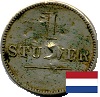
Can someone explain why the monograms of the 1935 and 1936 coins say GRI and ERI instead of GRV and ERVIII?
If it is because they were the first British rulers of New Guinea with those names and titles (which I suspect is not the right explanation), did the British do the same anywhere else?
This reminds me of the 1952 debate as to whether Elizabeth should be "II" in Scotland as well (where Elizabeth I never ruled).
Quote: "Camerinvs"Can someone explain why the monograms of the 1935 and 1936 coins say GRI and ERI instead of GRV and ERVIII?
I don't think there's any real reason behind it, because the New Guinea George VI coins also say GRI (which like ngdawa pointed out, is for Georgius Rex [et] Imperator).
(Also side note @ngdawa: The ERI is for Edward VIII; no New Guinea coins were issued during Elizabeth II's reign! She was never an empress, because India became independent in 1947; but if she had been, then her Latin title would've been "Imperatrix".)
Quote: "Camerinvs"Can someone explain why the monograms of the 1935 and 1936 coins say GRI and ERI instead of GRV and ERVIII?
(Also side note @ngdawa: The ERI is for Edward VIII; no New Guinea coins were issued during Elizabeth II's reign! She was never an empress, because India became independent in 1947; but if she had been, then her Latin title would've been "Imperatrix".)
LOL! I totally forgot about King Edward! I just automatically assumed "E" was for Elizabeth, I didn't even think twice about the mentioned dates.
Aghh! ─ The worst is that I actually knew it meant "Imperator"! Thanks for reminding me.
In many Commonwealth countries they actually struggled in 1947-1948 to replace the observe legend with the shorter title without "ET IND IMP". As you know, that explains the 1947 Canadian issues with a maple leaf after the date. These are actually 1948 coins.
Quote: "sc.rednek"Shouldn't Persia be next, not Peru?
We're still at Pa, you know.
Originally I wasn't going to include the ancients issuers, since usually nobody posts for them; but I realise quite a few people are going to want to show their Sassanid drachms and whatnot, so I added Persia for tomorrow.
Quote: "sc.rednek"Shouldn't Persia be next, not Peru?
We're still at Pa, you know.
Originally I wasn't going to include the ancients issuers, since usually nobody posts for them; but I realise quite a few people are going to want to show their Sassanid drachms and whatnot, so I added Persia for tomorrow.
or, we do another one just with the ancient and medieval republics/kingdoms/empires/caliphates etc.
Quote: "phfoticus"One possibility for ancients is to do them at the end, maybe in three days -- Rome, Greece (etc.), and other.
yeah, that works too..ibdon't think we think start now, half way through, to add "fallen kingdoms"..
Sounds good to me- I'm going to let someone else, probably ngdawa handle that, then.
In the meantime I'm going to exclude all ancients issuers from here on except for Persia and Rome, the more popular ones, and at the end we can do a rehash of all the ones we didn't do.
Quote: "Camerinvs"I wonder what percentage of those coins ever got to the shores of Pitcairn. I suspect less than 1% ─ or more accurately, less than 1‰.
only the amout the pitcairnese(?) are buying. i would say 0%.
Yes ─ closer to 0% than to 1‰. I suspect that coin collecting would be a great hobby in such a place and that a few of the Pitcairn inhabitants would be interested in owning coins issued in the name of their remote archipelago.
Quote: "Camerinvs"Yes ─ closer to 0% than to 1‰. I suspect that coin collecting would be a great hobby in such a place and that a few of the Pitcairn inhabitants would be interested in owning coins issued in the name of their remote archipelago.
I pity the coin collector who lives on Pitcairn, something tells me there aren't a lot of dealers there.
A lot of NCLT issuing countries (except the big ones like Canada) usually have the private mint they contracted to make the coins provide them directly to dealers; this is especially true for CFA franc countries like Côte d'Ivoire. I doubt the NCLTs they issue ever even actually go to the country in whose name they are made in.
Quote: "CassTaylor"I pity the coin collector who lives on Pitcairn, something tells me there aren't a lot of dealers there.
A lot of NCLT issuing countries (except the big ones like Canada) usually have the private mint they contracted to make the coins provide them directly to dealers; this is especially true for CFA franc countries like Côte d'Ivoire. I doubt the NCLTs they issue ever even actually go to the country in whose name they are made in.
With a population of about 50 in Adamstown,¹ I'm not going to buy stocks from anyone who starts a coin store there.
The NCLTs are like the stamp collector's CTOs. I doubt many Sarjah's Moon Landing stamps ever reached Sarjah.
___________________
¹I have found out they're called "Pitcairn Islanders".
This is my version of the same coin. Obviously it suffered from fire, and as I argued elsewhere, maybe that was the great fire of March-April 1945 which ruined most of Danzig.
Ceitil of Manuel I
This one is from Cabral's time - literally.
The voyage of Pedro Álvares Cabral to India and his discovery of Brazil was on Manuel I reign, so this coin is from the very beginning of Brazil's history.
I've bought without thinking twice when I saw it, it's not everyday you see a coin from the first years of your country.
1 and half Real (João IV?)
(left photo rotated on upload, don't know why)
Collection of those and mid century coins from 10 centavos to 2.50 Escudos I sold last year
I love coins. Especially silver, gold and anything really old.
Member of the Royal Numismatic Society of New Zealand and the Auckland Numismatic Society
Some more coins from the Kingdom of Portugal:
Pataco/40 Reis 1825 - King João VI
500 Reis 1859 - King Pedro V
100 Reis 1910 - King Manuel II (Last King of Portugal)