Map of modern Armenia. In green the unrecognised entity of Nagorno-Karabakh, controlled by Armenia but internationally viewed as part of Azerbaijan. Abkhazia and North Ossetia are de facto independent but internationally viewed as part of Georgia.
History
Armenia's history is marked by the many foreign entities that conquered it and conflicts with neighbouring nations. Persians, Byzantines, Arabs, Seljuk Turks, Mongols, Ottomans and Russians have at points in history dominated Armenia, or were allied with it to use it as a buffer against other rivals. The Armenian language has its own alphabet which has been in use since antiquity.
Antiquity
The earliest civilisations that dwelled in present-day Armenia date from 4000 BC. In the 6th century BC, the Orontid dynasty was the first Armenian state, evolving to the Kingdom of Armenia that reached its greatest extent in the first century AD under Tigranes the Great, when it was a eastern neighbour of the Roman Empire. In 301 AD, Armenia became the first state in the world to adopt Christianity as the state religion.

The Kingdom of Armenia under Tigranes the Great (96-69 BC).
Middle Ages
In 428 Armenia was conquered by the Persian Sassanid Empire. From 636 Armenia was an emirate within the Arab Empire, with its own prince. In 884 Armenia regained its independence, which lasted until 1045, when the Byzantine Empire took control of the area, only to be replaced by Seljuk Turks in 1071. Armenians found refuge in southern Anatolia where with help of the Byzantine Empire the Armeniam Kingdom of Cilicia was established in 1198. Cilicia played a role during the Crusades allying themselves with the invading forces from Europe, and at some point even allying with the Mongol Empire to hold off Egyptian Mamluks from conquering the area, but in 1375 the latter was succesful in conquering it.

Location of Cilician Armenia around 1200. In the southern Caucasus, Zakarid Armenia emerged as a fief of the Kingdom of Georgia.
Meanwhile in 1201, the Seljuk Empire was defeated and Zakarid Armenia was founded in the southern Caucasus as a fief of the Kingdom of Georgia. In 1236 the Mongols took over from the Georgians. In subsequent centuries Armenia was often raided by the various regional powers, until it was divided by the Ottomans in the west and Persians (Safavid Empire) in the east. Cilicia became Ottoman in the 16th century.
Russian influence
At the start of the 19th century the Russian Empire was expanding at the expense of the Persian Qajar Empire, and by 1828 Eastern Armenia had become fully Russian. Population transfers from and to the Ottoman Empire and Persia made Armenians the majority in Russian Armenia, after declining earlier to as low as 20% of the population.
Especially the position of Armenians in the Ottoman Empire was problematic as the non-Muslims were forced to pay tributes to Muslim authorities and the Ottomans more and more started distrusting Armenians for siding with the Russians with whom they share the Christian religion. All of this culminated in decades of violence. Armenians, feeling strengthened by the succesful revolts of Christian nations in the Balkans and the increasing might of the Russian Empire that weakened the Ottomans, demanded more and more rights. This was countered by large scale repression which resulted in the death of around 200,000 Armenians around 1896. Also in later years Armenians were often the target of ethnic cleansing campaigns. Many Armenians fled for the West, with large communities in France and the United States.
The First World War saw the Ottomans again facing the Russian Empire to its northeast. Many Armenians living in the Ottoman Empire volunteered for the Russian Imperial Army which was initially succesful in conquering parts of Western Armenia in 1916. But in 1917 the Russian front collapsed and the Ottomans recaptured lost territories. Western Armenia was almost completely ethnically cleansed, resulting in the deaths of more than a million Armenians. During the Armenian/Russian occupation of the Trabzon area, more than 120,000 Turkish were killed and many more removed from their homes. The extreme ethnic violence of that era is still hotly debated today, where Armenians call it a genocide and Turkish see it as part of a two-way conflict with atrocities committed by both sides. It is one of recent history's tragic examples of how troublesome ethnically divided regions can be the scene of horrific cruelty of human kind.

Armenia from 1918 to 1920. In orange the Republic of Armenia. In light green the parts of Ottoman Armenia that were assigned to Armenia in the Treaty of Sèvres. The Turkish resisted and the claim never materialised. The Soviet Union annexed Armenia in 1920 and made a separate deal with Turkey defining the borders.
First Armenian Republic (1918-1920)
As the Russians retreated from WW1, the Ottomans claimed territory up to Georgia. Armenia, Georgia and Azerbaijan united in a fragile state called the Transcaucasian Democratic Republic. The Ottomans were able to conquer all of Western Armenia. The union was dissolved in 1918 with the 3 nations becoming independent. Immediately war broke out between Armenia and Azerbaijan. In 1920 the Red Army conquered all of Transcaucasia, fixed the border with the Turkish Republic that had just emerged out of the ashes of the Ottoman Empire and established the Transcaucasian SSR. Armenia, Azerbaijan and Georgia became separate SSR's in 1936.
Modern Armenia
With the reforms in the Soviet Union kickstarted by Mikhail Gorbachov, nationalist groups gained power in various parts of the USSR. Already before Armenian independence in 1991, a military conflict broke out between Armenia and Azerbaijan over the Nagorno-Karabakh region, an enclave with an Armenian majority located in Azerbaijan. A nasty conflict erupted that resulted in over a million displaced people and Armenia occupying vast amounts of Azeri territory. A fragile ceasefire was brokered by Russia in 1994, but tensions remain to date.
Due to an age of conflict Armenia's borders with Turkey and Azerbaijan are closed. Nagorno-Karabakh has become an unrecognised republic, and many people are not able to return to their ancestral homes. Landlocked and short in natural resources, Armenia's economy is in worse shape than those of its direct neighbours. A sustainable solution for Nagorno-Karabakh seems to be lightyears away.
Currency and coins
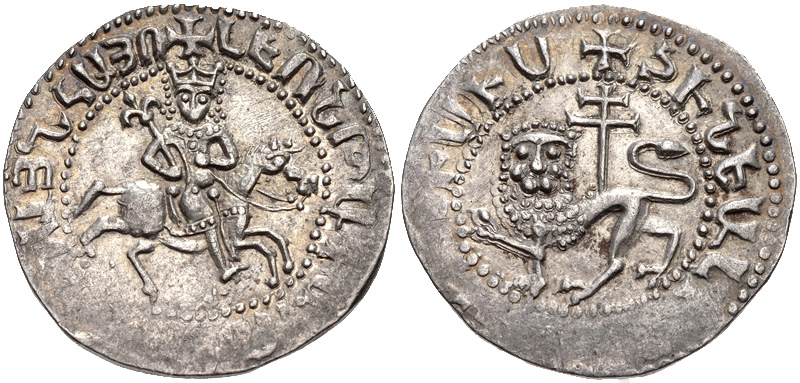
During the rule of Tigranes the Great the Kingdom of Armenia minted its own coins following the Greek system of 1 Drachme = 6 Oboli = 48 Khalkoi. Coin legends were still in Greek. In the middle ages, Cilician Armenia issued coins denominated in Tram (from Drachme, Arabic: Dirham). Their designs featured detailed portraits of Cilician kings and legends in Armenian.
Foreign currency was used in Armenia for many centuries. During the short-lived Armenian First Republic (1918-1920) Armenia used its own paper ruble, which was replaced by the Transcaucasian Ruble in 1920 and Soviet Ruble quickly after.
In 1993 Armenia, with Russia unilaterally ending the Ruble zone to curb inflation, Armenia introduced its own Ruble only in the form of banknotes. In November 1993 a new national currency named Dram (=100 Luma) was introduced at a rate of 200 Rubles per Dram. Initially worth 400 Dram per USD, it dropped to around 500 Dram per USD by 2016.
The first series are aluminium coins dated 1994. In 2003 a new series was introduced with higher denominations.
Coins of Cilician Armenia (1196-1375):
https://en.numista.com/catalogue/cilician-armenia-1.html
Coins of Armenia:
https://en.numista.com/catalogue/armenie-1.html
Coins of Nagorno-Karabakh:
https://en.numista.com/catalogue/haut-karabagh-1.html

 You seem to take all hot-spots at once, did you?