History
Present-day Romania was part of the Roman Empire where it was known as Dacia. Dacians spoke a Thracic language but Latin was adopted as a result of immigration from other parts of the Roman Empire. This explains why Romanian is a Romance language which has some similarities with Italian.
Middle Ages
In the 14th century, the Principalities of Moldavia and Wallachia emerged in Romanian lands. The third region with a large share of Romanians is Transylvania, which was at that time part of the Kingdom of Hungary.
Ottoman vassals
By the 16th century both Moldavia and Wallachia became part of the Ottoman Empire, although they remained relatively independent. In 1600 Prince Michael the Brave unified the principalities and Transylvania which was to become the first Romanian state, but it came to an end already in 1601.

The first Romanian state under Michael the Brave (1600-1601).
In 1770 the Russian Empire occupied Moldavia and Wallachia during the Russo-Turkish War of 1770-4. Despite being victorious the Russians left the area in exchange for territorial gains in southern Russia and Ukraine. The Russian Empire saw itself as the protector of all Christians in the Ottoman Empire and would remain active to increase its influence in the region. In 1821 the east part of Moldavia was annexed, roughly corresponding with present-day Republic of Moldova.
Independence
In 1859 Moldavia and Wallachia became a personal union under Prince Alexandru Ioan Cuza, effectively laying the foundation of modern Romanian. He was deposed 7 years later by a coup in which Carol Hohenzollern-Sigmaringen took power as Prince of Romania. In 1878 Romania became fully independent after it had sided with Russia in yet another Russo-Turkish War. Carol was proclaimed king in 1881.

Romania between 1859 and 1878. Transylvania remained part of the Kingdom of Hungary. In 1878 Romania was awarded the Black Sea coast (Northern Dobruja) but ceded a small area north of the Danube Delta to the Russian Empire.
World War I
In World War 1 Romania was initially neutral but joined the Allies in 1916 with promises over gaining Transylvania from Hungary. Victorious against both Hungary and later Russia Romania's territory was largely extended to include most Romanians living in the region.
Interwar Romania
In 1927 King Ferdinand died leaving the throne to the 5-year old Michael (Mihai). His father Carol had divorced his mother and removed from the line of succession. However, he proclaimed himself king in 1930 and ended Michael's rule. Carol II was an authoritarian king in times of political turmoil. Fascist leader Ion Antonescu rose to power and led Romania until 1944.

Romania from 1920 to 1940. In 1913 Southern Dobruja was annexed from Bulgaria. In 1918 Transylvania was added and in 1920 Bessarabia (eastern Moldavia).
World War II
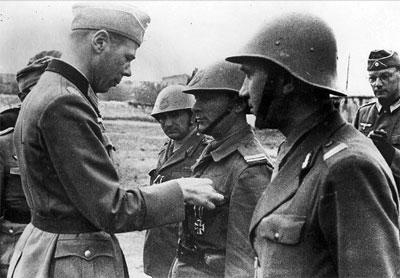
At the start of WW2 Romania was forced to cede Bessarabia to the USSR, which merged it with the Moldavian ASSR (present-day Transnistria) to form the Moldovan SSR. Northern Transylvania was ceded to Hungary that year as well under threat of Nazi Germany. Fascist leader Antonescu allied with Nazi Germany and took part in Operation Barbarossa in 1941. Romania annexed Transnistria and beyond to include the city of Odessa, an area where only 10% spoke Romanian as a native language. Fascist policies, especially in Transnistria, resulted in the deaths of more than 300,000 people, most of which Jews.

Romania from 1941 to 1942. It lost a part of Transylvania to Hungary and Southern Dobruja to Bulgaria in 1940 but liberated Bessarabia (taken by the Soviets in 1940) and annexed the Transnistria Governorate in 1941. Especially in the latter area Romanian fascist policies were harsh, feeding anti-Moldovan sentiments even today. After WW2 Transylvania was returned but all other 1941 gains returned to the USSR.
In 1944 the Red Army reached northern Moldavia. Romanian communist leaders convinced King Michael to topple Antonescu in a coup and as a result switch sides in the war. For this, King Michael was seen as a hero but the effects were mixed. Many Romanian soldiers were interned by the USSR and the country would see large Soviet military presence until 1956. King Michael was the last monarch in the Eastern Bloc to abdicate. Despite earning a Soviet medal for bravery for his role in toppling Antonescu he left into exile in 1947.
Communist Romania
The People's Republic of Romania was founded in 1947. In 1965 Nicolae Ceausescu took power and renamed the country to the Socialist Republic of Romania. His policies were marked an independent course from the Warsaw Pact. He refused to take part in the invasion of Czechoslovakia in 1968 and even openly condemned it. But by the 1980's policies turned disastrous for most Romanians. Ceausescu wished to pay back foreign debt by severe austerity and refused to devalue the currency which led to a large shortage of basic necessities. The wave of revolutions in Eastern Europe in 1989 also spread to Romania. It was the most violent one, with skirmishes between the Securitate and the army which sided with the protesters.
Post-communist Romania
Romania adopted a new constitution 1990, ending the communist era. The currency collapsed and the first years were extremely difficult. Since the 2000's Romania's economy has grown steadily, but it has also seen a large group of skilled workers leave for Western Europe since Romania joined the EU in 2007. Tourism is becoming increasingly important, which is helped by the country's diverse scenery and historic sites.
Currency
Middle ages
The newly established principalities of Moldavia and Wallachia minted their own coins in the 14th century, based on the Ban and Denar. Because there was no steady supply of silver not many were produced and foreign coins started to dominate in the area. From the 16th century Dutch-Flemish Leeuwendaalders (Lion Thalers) became very widely used in Southeast Europe, which explains the currency names Leu, Lev and Lek that are still used today.
18th century
From 1770 to 1774 the two principalities of Moldavia and Wallachia were occupied by Russia during the Russo-Turkish War of those years. The Russian administration minted copper coins specifically for the 'Danube principalities' where 3 Kopeks equalled 2 Ottoman Paras. After 1774 the Ottomans returned and Ottoman currency was again the main currency used.
First Leu (1866-1947)
Though nominally not independent, the United Principalities were looking to introduce their own national currency based on the French Franc and the Latin Monetary Union (LMU) standards. The name 'Roman' was suggested but only pattern strikes were ever minted. Instead, the new leadership under Prince Carol chose the Leu, divided in 100 Bani and at par with the LMU currencies, although that only became formal in 1889. Parity with LMU Francs meant that 5.18 Lei was equal to a US Dollar and 25.22 Lei equal to a British Pound.
In 1914 the gold standard was abandoned, leading to a stop in production of coins. Especially after 1918 the Leu dropped sharply, reaching 160 Lei/$ by 1929, when a new gold standard was adopted. Silver coins were reintroduced in the 1930's but with much higher denominations.
From 1940 the Leu was pegged to the Reichsmark at 50 Lei/RM. From 1944 the Leu fell sharply. It was redenominated in 1947 at a rate of 20,000 to 1, with no warning given to the population and limits to the convertibility of the old Leu. Many people lost their savings.
Second Leu (1947-1952)
The Second Leu was nominally pegged to 150 Lei/$. It lasted only five years as the authorities decided to do another round of currency reform in 1952, again without prior warning. The Third Leu replaced the Second Leu at a variable rate of 20-400 to 1 new Leu.
Third Leu (1952-2005)
The third Leu was pegged to 6/$ in 1954, but it was illegal for private individuals to buy and sell foreign currency. In the 1980's this caused a shortage in goods as foreign trust in the Leu vanished and the fictitious exchange rate made it difficult to import goods, leading to the rationing of basic necessities in 1986. After the fall of communism inflation went as high as 300% per year. In 1992 there were around 450 Lei in a US Dollar, and by 2003 around 40,000. From there the currency stabilised laying the groundwork for redenomination in 2005.
Fourth Leu (2005-date)
In 2005 four zeros were chopped off for a new Leu. Ever since the Leu has been relatively stable around 4 RON/$, reflecting structural improvements in the Romanian economy since that time.
Coins
Romania is a nice country to collect coins from. The often unstable currency produced many coin types and lots are available at bargain bin rates. Many historical eras are nicely collectible.
Romania's LMU coinage is a bit harder to come by, especially in the better grades. In 1930 two coin types were produced with King Michael as a young boy. King Michael still lives, and even plays a minor role in present-day Romania. The 1930's and 1940's saw many coin types issued as the head of state switched twice and the currency's value was unstable, with frequent attempts to regain trust by issuing new silver coins at higher nominal values.
Those who love high denominations probably like the silver 100,000 Lei coin dated 1946. It hardly circulated as the currency was reformed already in 1947, and the communist confiscations made people hoard the coins for their precious metal content. They can be found these days for around 15-20 EUR a piece.
Early communist-era Romanian coins are unexpectedly hard to find. Though made of base metal, these usually cost over 5 EUR in above VF grades in Western Europe. Coins from the 1960's and after are a lot easier to find, as well as the post-communist coins from the Third Leu.
Coins currently in circulation are the 5, 10 and 50 Bani.
Coins of Moldavia & Wallachia:
https://en.numista.com/catalogue/moldavie_valachie-1.html
Coins of Romania:
https://en.numista.com/catalogue/roumanie-1.html


 Sorry - WW2 enthusiastic


 :
: