

The flag of Oman

CIA World Factbook map of Oman - notice the northern exclave!
Actually, this geography gets even worse: that little patch of disconnected Omani territory labeled "Madhah" contains within itself an even smaller patch of disconnected U.A.E. territory known as "Nahwa". Next time you're in the Gulf area, why not go and visit one of the world's few "second-order exclaves".
First, here's some useful coin-identification advice: all coins from Oman depict the country's emblem, a traditional khanjar dagger.
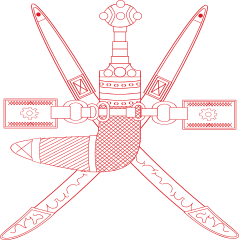
Oman is another Middle Eastern country that is not in the news very often - its oil production is middling, its religious situation is currently harmonious, and its income is high. The nation scores 1.889 on the Global Peace Index: Syria, the least peaceful nation on Earth, scores a 3.650, and the United States languishes at 2.137. We are always hearing about Sunni Muslims and Shia Muslims, but Oman is home to the world's largest (and only significant) concentration of Ibadi Muslims, a fairly obscure sect.
The Krause catalog splits Oman in two: coins from before 1970 are considered to be from "Muscat and Oman", an entity that existed under British protection. Historically, Oman really got around: the Sultanate of Muscat built a little colonial empire of its very own, seizing Zanzibar and various other coastal settlements, and becoming very rich by taking slaves from its African holdings. But these naval pretensions were no match for those of the British Empire.
Like many other Gulf states, Oman did not issue very many coins in its early modern history, preferring instead to use the British Indian rupee. However, the Sultan did issue a few low-denomination copper coins, possibly because the cost of shipping over low-value British Indian copper was not that much less than the cost of just striking low-value Omani copper with relevant national symbols and vernacular legends.


Typical British Indian coins
The first really modern Omani coins were introduced in 1940, for use in the large and arid Dhofar Governorate, the part of Oman that borders Yemen. The first issues for all of Oman were issued in 1946. But, again, British Indian coins continued to circulate alongside these, so these earlier issues are uncommon. Arabic has no letter "p", so the name of 1/1000th of an Omani rial - a "baisa" - is directly related to the Indian "paisa".

One of the rarely seen Dhofar special issues
More denominations were sporadically issued from time to time, including some attractive silver rials in the 1950s and 1960s, but Oman's first comprehensive national coinage was only introduced in 1970. In that year, denominations ranging from 2 to 100 baisa were introduced.

2 baisa, 1970
Another important event happened in 1970 - Sultan Said bin Timur was overthrown by his son Qaboos bin Said, who set out to end Oman's isolation and modernize the country (...while retaining his power as an absolute monarch). One of Qaboos' first acts was to change the country's name from "Muscat and Oman" to "Oman", thus making life just a little bit easier for students of geography across the world. (Another one of his radical reforms was to outlaw slavery - yes, in 1970! This makes Oman just about the last country on earth to do so.) Should Muscat and Oman be given its own listing in the Numista catalog, because of this important name change? You decide, because for once I just don't care very much.
Qaboos bin Said is actually still in power today, making him the Middle East's longest-lasting current ruler, and he is still essentially an absolute monarch - but a progressive absolute monarch, especially compared to the Saudis right next door. Women have been able to vote and stand for election in Oman since 1997, and the country introduced universal suffrage in 2002 - but, of course, most of the actual power remains in the Sultan's hands. So I guess, in the end, his efforts to modernize the country while staying firmly in charge worked very well indeed.


Earlier issues from Qaboos' reign - notice the lack of a Christian date
As a sign of Oman's modernization, its more recent coins have begun displaying both the Muslim and Christian eras, for the convenience of expats and foreign workers. Oman boasts a significant population of expatriates and foreign workers, with 2,230,000 native Omanis living in the same country as 1,760,000 non-Omanis - although this seems like an incredible figure, Oman actually has one of the lower non-native populations in the Gulf region. For instance, native Emiratis form only 16.5% of the total population of the United Arab Emirates! This relatively low foreign population (and relatively low absolute population) may explain why Omani coins are significantly less common than coins from other Gulf states.


Modern Omani coins
You might notice that Omani coins have changed very little during Qaboos' long reign: the Omani rial is one of the strongest currencies in the world, with 1 rial being permanently pegged at USD $2.60. So these seemingly low-value coins (0.005 of a rial, 0.025 of a rial, etc.) are actually worth a fair bit, and Oman even issues a 1/10 rial banknote. Omani coins are fairly austere, but the banknotes are quite colourful and beautiful - too bad they're pretty hard to come by.
Numista page for Oman


