The Democratic Republic of Congo is a country in Central Africa named after the Congo river. It is one of the largest countries in Africa and the largest francophone country in the world with a population of 75 million. It is also one of the poorest and least developed states on the globe, despite abundant natural resources.
The Portuguese never went far upstream the Congo river during their ventures in Africa. At the same time, the eastern part was often visited by Arab slave traders. In the 1870's Belgian King Leopold II sent British explorer Sir Henry Morton Stanley to investigate the area. In 1885 Congo was awarded to Leopold II during the Berlin Conference, and it was named the Congo Free State. He made a lot of money exploiting the locals for his rubber enterprises. Due to bad conditions and epidemics many millions of Congolese died, but no accurate records exist.
International pressure led to the annexation of Congo Free State by the Belgian state in 1908, which marked the start of Belgian Congo. Belgian Congo was involved in WW1, when the Belgians attacked German East Africa together with the British, and were awarded the province of Ruanda-Urundi in 1916.
In 1960 Congo was granted independence, with Patrice Lumumba becoming the first prime minister. A power struggle soon broke out between the leftist Lumumba and Joseph Kasavubu. At the same time, the south eastern province of Katanga seceded from Congo. Lumumba was arrested and brought to Katanga where he was assassinated by Kantangan troops under Belgian command. Meanwhile, army commander Mobutu Sese Soko, supported by the West who disliked Congo's flirt with socialism, organised a mutiny and took power. Katanga was reunited with Congo in 1963.
Mobutu changed the name of Congo-Léopoldville to the Democratic Republic of the Congo in 1965, only to change it again in 1971 to Zaire, after the local name of the Congo river. Mobutu ruled with iron fist and enriched himself shamelessly in an impoverished country.
In 1997 Mobutu was deposed after a rebellion led by Laurent-Désiré Kabila. Kabila restored the name of the country to Congo DR. A second Congo war erupted in 1998 involving many neighbouring countries. Millions of Congolese died, mostly due to famine and disease.
In 2001 Kabila was assassinated by his bodyguard and his son Joseph took over. Even up to now the country has experienced a lot of violence and instability caused by local rivalries and intrusions by mainly Rwandan forces.
Congo used its own coins already from the days of the Free State, with a Franc at par with the Belgian Franc. When yhe Free State came to an end, the legends on the coins were updatex. In the 1920's, new 50 centimes and 1 Franc coins were introduced showing a palm tree, symbolising the palm oil plantations. In the 1950's the palm trees appeares again on coins, now with Ruanda-Urundi added to the legends.
After independence Congo-Léopoldville kept the Franc, and a nice aluminium 10 Francs coin was issued featuring a lion.
In 1967, the Zaire was introduced at a rate of 1 Zaire = 1000 Francs. The Zaire had an unusual subdivision of 100 Makuta and 10,000 Sengis. Its initial value was 1Z = $0.50, but this inflated away gradually over the years. Only a few coins were issued, including the 1Z, 5Z and 10Z in 1987, which were the last Congo/Zairean circulation coins to be produced until now. In 1987 the rate was 112Z/$. Inflation was fierce from 1990 and in 1993 the Zaire was replaced by the New Zaire at a rate of 3,000,000 to 1, with 3 New Zaires worth one USD.
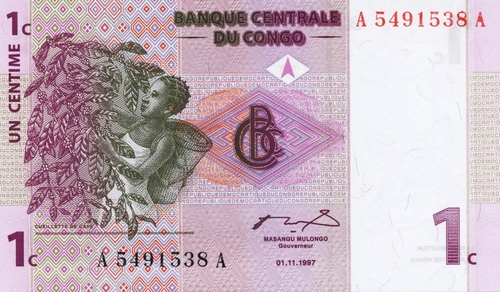
Due to the civil war also the New Zaire quickly lost value and in 1997 it was replaced by the Franc at a rate of 100,000 to 1. The Congolese Franc now trades at around a 1,000 per USD. No coins are used for this currency.
Congo Free State:
https://en.numista.com/catalogue/congo_independant-1.html
Belgian Congo:
https://en.numista.com/catalogue/congo_belge-1.html
Belgian Congo & Ruanda-Urundi:
https://en.numista.com/catalogue/ruanda-urundi-1.html
Zaire:
https://en.numista.com/catalogue/zaire-1.html
Congo DR:
https://en.numista.com/catalogue/republique_democratique_du_congo-1.html
World coins chat: Congo & Zaire
13 posts
» Quick access to the last post






Used time zone is UTC+2:00.
Current time is 09:23.