2 British halfcrowns from 1920, these are the Large Head and Small Head varieties used in that year.
Almost impossible to tell apart.
Except for this!
Yep its the positioning of the I in "Dei" - points between beads or to a bead. Sadly they started with "Big heads" and moved to the "Small heads" which were higher relief and meant they wore quicker (90% of 1920 - 1926 50% silver British coins are always found worn).
These two were cheap as they were worn and the Small Head coin was pretty badly cleaned. The rest of April promises to improve for me!
I love coins. Especially silver, gold and anything really old.
Member of the Royal Numismatic Society of New Zealand and the Auckland Numismatic Society
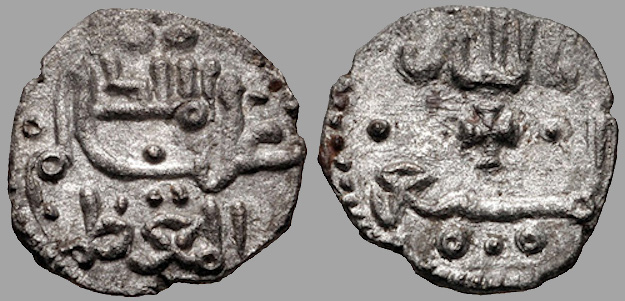
Picked up several Norman-Sicily coins, but they will take some time to attribute. Here is one that I just finished...
Normans in Sicily: William II (1166-1189) BI Dirham Fraction, Palermo (Spahr 116; Travaini 367; MEC 400)
Obv: Kufic legend in three lines - الملك غليوم المعظم (King Guglielmo, the Great)
Rev: Kufic legend in two lines - المعتز بالله (Victorious through God); in center, cross potent flanked by pellets
Dim: 10mm, 0.52 g, 11h
Think I may stop posting mine here, worn halfcrowns and shillings from the late 19th and early 20th century don't compare with medieval and ancient rarities.
I love coins. Especially silver, gold and anything really old.
Member of the Royal Numismatic Society of New Zealand and the Auckland Numismatic Society
That is never the case...I collect coins from all periods up to the middle of the 20th century. WWII messed up most coinage IMHO and thus, rarely do I venture beyond that. The era of modernization was upon us and thus, the designs are somewhat blaahh...
So, please go ahead and post them! If I like a design, I might just go out and get a modern coin. The last one I purchased was a Mexican 50 pesos from 1983 based on an "Additions to your collection" post. The design was so nice and up my ally that I had to have one in my collection...
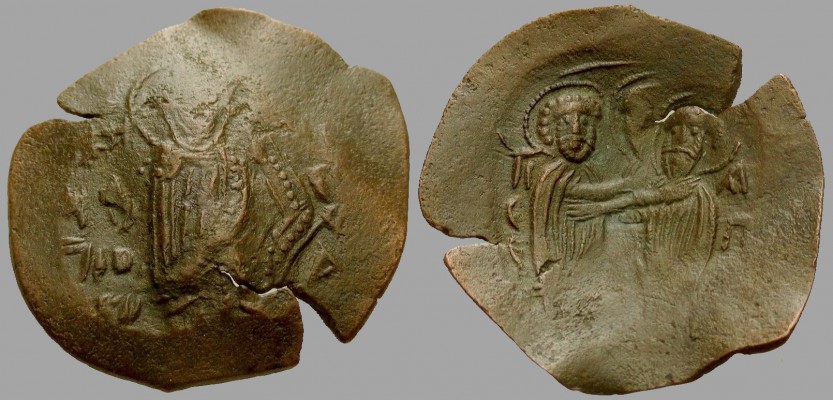
Not all is nice and shiny in Quant-Geek land! There are so many coins that I have where the quality is sub-par AND common. Most of my focus is on medieval eastern Christendom and Islamic Dynasties, so here is a recent lot of Bulgarian coins. These are usually dogs and thus difficult to get in good condition. Anything VF and above are hard to find. I do have several in really nice condition, but this lot fills the holes in some places as there are some rare coins in this lot:
Latin Empire of Constantinople: Anonymous (ca. 1204-1261) Æ Large Module Trachy, Constantinople (Sear 2040; DOC 20)
Obv: MP ΘV H AΓIOCOPITICA in two columnar groups; Full-length figure of Virgin Hagiosoritissa nimbate, orans; Manus Dei in upper right field
Rev: O AΓIOC ΠЄTPOC O AΓIOC ΠAVΛOC in two columnar groups; Full-length figure of St. Peter, on left, and St. Paul, on right, nimbate, wearing tunic and kolobion, embracing each other; St. Peter has short beard, St. Paul has a long one
Okay then, but I am not complaining about all these nice early coins. They fascinate me greatly - I just consider myself a bit simple to collect such beauties. My worn Victorian and early 20th century coins however just draw me back.
You guys impress me by collecting and showing them, I would find it so hard reading and understanding a coin not written in a modern language or modern Latin.
Here is some more worn Halfcrowns and shillings for you I got today.
1846 Halfcrown, a spacefiller and as nasty as they get. This is truly awful but what a fascinating coin and it really fills a gap for the time being.
1898 high VG/low fine - a date I need and an acceptable coin at not much above melt
1904 - good Fine piece, another date that alluded me
1907 another acceptable piece that does the job filling an empty space marked "1907 UK shilling".
And at least they are sterling silver, so its money in the bank.
I love coins. Especially silver, gold and anything really old.
Member of the Royal Numismatic Society of New Zealand and the Auckland Numismatic Society
Quote: "Moneytane"You guys impress me by collecting and showing them, I would find it so hard reading and understanding a coin not written in a modern language or modern Latin.
Its all about the books! If you don't have the resources, then it is next to impossible to read and understand the coins in a foreign language. I only know English fluently, so I am in the same boat as you. But, once I have google translate, website sources, and reference books, its off to the races!
The above Latin Rulers attribution is copied in verbatim from a book. I just used Google Translate to type in the Greek letters. My belief is that collectors (and non-collectors as well) have a greater appreciation for coins that are in a foreign language if they knew what it says. So, I spend a lot of time attributing my coins as close as possible...
Some old Spanish American silver. Nothing special, just fun stuff. I am fine with problem and low grade coins.
Something like the Lima mint one was discussed on another thread recently.
Jamais l'or n'a perdu la plus petite occasion de se montrer stupide. -Balzac
Quote: "Mr. Midnight"Some old Spanish American silver. Nothing special, just fun stuff. I am fine with problem and low grade coins.
Something like the Lima mint one was discussed on another thread recently.
The 2 small coins are Mexican - Mexico City Mint.
Quote: "Mr. Midnight"Some old Spanish American silver. Nothing special, just fun stuff. I am fine with problem and low grade coins.
Something like the Lima mint one was discussed on another thread recently.
The 2 small coins are Mexican - Mexico City Mint.
Aidan.
· All from the same seller, so savings postage. After I won the first item I looked at
other items being sold, and over a week built the purchase up to those seven.
· I particularly wanted to see the silver colour item in hand to try and read it.
· Everything about it says hand made. Uneven shape [38 to 41mm], uneven edge [1.5 to 2.0mm],
hand-drawn people, hand-drawn lettering. Will give it a few weeks to work out what it says,
then may add it to the Identifications forum.
Quote: "ZacUK"
· Everything about it says hand made. Uneven shape [38 to 41mm], uneven edge [1.5 to 2.0mm],
hand-drawn people, hand-drawn lettering. Will give it a few weeks to work out what it says,
then may add it to the Identifications forum.
Now that is pretty awesome!! Congrats on that acquisition...
Update: This is what I did tonight, so far. A work in progress >
Obverse: Rebellion u Krigs Andenke 1791 92 93 94 / 1795 Friede mit Preussen und Frankreich
Reverse: 1791 Haben sie den Kaiserem oben gz ... ... den Schweden stadt /
... ... ... der Franzosen auch ... den Kopf ... [off flan]
Black - most likely / Green - maybe / Red - guess
Figures A B C D presumably kings as may be wearing crowns. E at end may be a skeleton.
Some more worthwhile pieces from me. 3 nice but cleaned halfcrowns and 4 really nice florins!
All United Kingdom
1817 Halfcrown - Bull Head type - VF/gVF cleaned and some damage
1900 Halfcrown - Historically cleaned? - aEF/EF
1901 Halfcrown - EF details harshly cleaned and dipped
Florins soon (They are not cleaned!)
I love coins. Especially silver, gold and anything really old.
Member of the Royal Numismatic Society of New Zealand and the Auckland Numismatic Society
1942 UNC - Look at the central rose middle pattern and the misty feel of it.
1943 lower AU - compare the rose centre to the coin above!
I love coins. Especially silver, gold and anything really old.
Member of the Royal Numismatic Society of New Zealand and the Auckland Numismatic Society
Acquired some lovely Cuban notes, £10 for the whole set on ebay
was tough to find considering they're not even supposed to be on ebay and theres almost nowhere else thats reasonable to buy from.
Quote: "FlyingRedPanda"
Acquired some lovely Cuban notes, £10 for the whole set on ebay
was tough to find considering they're not even supposed to be on ebay and theres almost nowhere else thats reasonable to buy from.
-Nice picks up! And I share your pain. I've been 4 years on the look out for Cuban notes & nada. It's just been really tough for me to win ONE at any auction I've attended (online) as somebody always ends up beating my bids out. They always seem to go much higher than I expect too.
I started to identify a number of coins that I received earlier this week. Some of them came from some sort of world coin album that I'd be happy to know more about. Why? Because most coins are misattributed (which I knew before even bidding on them).
1- I don't know if there is any way to prove this attribution as "Celtic ring money"; I actually don't see how it would be possible unless you can prove that only the Celts made bronze or copper rings. Ideally each such piece should come with its own pedigree. These rings are easy enough to obtain.
2- I have not yet looked at this one in any detail:
3- This next one I posted already and Geison may be right about its ID (check link for two more photos):
4- The ID of this next one is right only for the provenience, Judea; the rest is all wrong:
Probably what's left of a prutah of Alexander Jannaeus. Tiniest coin in my collection, though I have a much better one already.
5- I am currently trying to ID this one:
The ruler seems to be identified as الملك محمد ("King Muhammad"). If so, this wouldn't be Malwa as the rulers were sultans.
6- This next one is a pretty obvious case of misattribution:
Quote: "Camerinvs"I started to identify a number of coins that I received earlier this week. Some of them came from some sort of world coin album that I'd be happy to know more about. Why? Because most coins are misattributed (which I knew before even bidding on them).
1- I don't know if there is any way to prove this attribution as "Celtic ring money"; I actually don't see how it would be possible unless you can prove that only the Celts made bronze or copper rings. Ideally each such piece should come with its own pedigree. These rings are easy enough to obtain.
There is no such thing as "Celtic Ring Money". Its a made-up name for Celtic ring-type artifacts. There is no indication that this was used as currency, unfortunately. One theory is that they are actually rings used for horse reigns. But vendors seem to use it to peddle this.
Quote: "Quant-Geek"
There is no such thing as "Celtic Ring Money". Its a made-up name for Celtic ring-type artifacts. There is no indication that this was used as currency, unfortunately. One theory is that they are actually rings used for horse reigns. But vendors seem to use it to peddle this.
Oh, yes! ─ I entirely agree! To call this "money" is quite a stretch. In fact, if one looks at the section "Primitive Money" in the catalogue, many if not most pieces are groundlessly called "money".
I have a couple of the so-called "hoe money" from Mexico, but I doubt this was ever used as money. Yet at least we can be pretty confident they weren't tools as thin copper/bronze axes would be pretty useless. They're found in great numbers in funerary contexts, which for some is enough to consider them "primitive money".
This reminds me of a discussion at lunch time during a small Economics conference 16 years ago. One of the presenters had demonstrated that there is no ground whatsoever to consider wampum a form of money. One of the other presenters was still on the fence (holding dearly to the consensus, as is often the case). The other guy pointed to his wedding band and asked him whether that was money... And the argument was closed.
Quote: "Quant-Geek"
There is no such thing as "Celtic Ring Money". Its a made-up name for Celtic ring-type artifacts. There is no indication that this was used as currency, unfortunately. One theory is that they are actually rings used for horse reigns. But vendors seem to use it to peddle this.
Oh, yes! ─ I entirely agree! To call this "money" is quite a stretch. In fact, if one looks at the section "Primitive Money" in the catalogue, many if not most pieces are groundlessly called "money".
I have a couple of the so-called "hoe money" from Mexico, but I doubt this was ever used as money. Yet at least we can be pretty confident they weren't tools as thin copper/bronze axes would be pretty useless. They're found in great numbers in funerary contexts, which for some is enough to consider them "primitive money".
This reminds me of a discussion at lunch time during a small Economics conference 16 years ago. One of the presenters had demonstrated that there is no ground whatsoever to consider wampum a form of money. One of the other presenters was still on the fence (holding dearly to the consensus, as is often the case). The other guy pointed to his wedding band and asked him whether that was money... And the argument was closed.
That doesn't preclude us from collecting them! I have a few of the "hoe money" as well. There is a very nice article about "hoe money" and the various types by Holser at https://www.jstor.org/stable/41263471. Attached is one of my "Celtic Ring Money":
Quote: "Quant-Geek"That doesn't preclude us from collecting them! I have a few of the "hoe money" as well. There is a very nice article about "hoe money" and the various types by Holser at https://www.jstor.org/stable/41263471.
**********************************************************************
Another coin I received in the mail this past week is this Athenian bronze (this one in the catalogue I think):
There's also this silver I haven't yet researched:
First addition to my collection in quite a long time:
The new Beijing Winter Olympics commemorative note from the Bank of China. I had originally not bothered to go out of my way to buy this one for its $138 asking price just because of how "samey" it felt. If you compare this to the regular-issue note it wasn't as drastic a difference as the Beijing 2008 edition, or indeed any of the other commemorative notes of the past (see SCB 2009, HSBC 2015). But when an old friend told me he'd gotten one specifically for me I couldn't say no.
"Life is all about being too wrapped up in the now to care about the future. When the future becomes the past, you start to regret what you've done."
Quote: "KS5331 Productions"First addition to my collection in quite a long time:
The new Beijing Winter Olympics commemorative note from the Bank of China. I had originally not bothered to go out of my way to buy this one for its $138 asking price just because of how "samey" it felt. If you compare this to the regular-issue note it wasn't as drastic a difference as the Beijing 2008 edition, or indeed any of the other commemorative notes of the past (see SCB 2009, HSBC 2015). But when an old friend told me he'd gotten one specifically for me I couldn't say no.
Whoa,
It's beautiful
I quite envy you
Numista Referee for Coins of Kingdom of Bahrain, Kingdom of Saudi Arabia, Republic of Tunisia & Kingdom of Morocco
🇧🇭🇸🇦🇹🇳🇲🇦
I am interested in post-Ottoman Greece. the First king was Othon, hired in from Bavaria. My first Othon era coin is this item,
no prize obviously, but decent details, a big hunk of silver at least, for small money.
Jamais l'or n'a perdu la plus petite occasion de se montrer stupide. -Balzac
Quote: "Mr. Midnight"I am interested in post-Ottoman Greece. the First king was Othon, hired in from Bavaria. My first Othon era coin is this item,
no prize obviously, but decent details, a big hunk of silver at least, for small money.
King Otto of Greece was from a branch of the Wittelsbach Dynasty.
Artuqids of Mardin: Husam al-Din Yuluq Arslan (1184-1200) Æ Dirhem (Album 1829.4; Whelan Type IV; S&S Type 36.2; Zeno 293026)
Obv: Turk, cross legged, seated facing, holding severed head and raised sword; نور الدين اتا / بك to right (Nur al-Din Atabeg); ornamental in exergue
Rev: Name and titles of the Abbasid caliph in three lines - الناصر لدين / الله امير المؤمنين (al-Nasir li-Din Allah, Commander of the Faithful); names and titles of Ayyubid overlord in inner margin - الملك الافضل علي و الملك الظاهر غازي بن الملك الناصر يوسف (the King al-Afdal 'Ali and the King al-Zahir Ghazi b. al-Malik al-Nasir Ayyub); name of Husam al-Din Yuluq Arslan and AH date in outer margin - حسام الدين يولق ارسلان ملك ديار بكر بن ايل غازي بن ارتق ضرب سنة ست و تسعين و خمس (Husam al-Din Yuluq Arslan, King of the Diyar Bakr, b. al-Ghazi b, Artuq, struck (in the) year 596)
Dim: 30 mm, 14.67g
Quote: "Mr. Midnight"I am interested in post-Ottoman Greece. the First king was Othon, hired in from Bavaria. My first Othon era coin is this item,
no prize obviously, but decent details, a big hunk of silver at least, for small money.
Fantastic coin, I know how hard it is to get coins of King Othon (Otto of Bavaria). All I could manage was a manky looking 10 Lepta. These copper coins merely showed a shield, no mention of who the Basileos was.
Early Greece is always hard, not many coins issued and very few precious metal ones, then the inflation ensured few were issued until 1954, when they become more common.
Greece is one of my favourite countries for coins and stamps
I love coins. Especially silver, gold and anything really old.
Member of the Royal Numismatic Society of New Zealand and the Auckland Numismatic Society
Scottish 40 pence of Charles I's 2nd coinage (1636)
The Edinburgh mint switched to striking coins by machine in the following year. That makes this one of Scotland's last ever hammered coins. It's double struck on both sides, but its most noticeable on the reverse crown and thistle. They are quite rare when compared to the later milled 40d coins.
A couple of recent pickups from the Ferrara (Italy) mint.
I am unsure of the attribution of this one, sold as a denaro c.1200-1344, but with a mass of 0.33 g., and 13 mm, smaller than any denaro I can find (size is generally 15 mm, and mass in the range 0.5 - 1.0 g). I am thinking it is possibly the mezzo denaro which had an identical design (CNI lists just a couple, at 12 mm and 0.25 g.). Alternatively a denaro that has been clipped, but I don't really see the evidence
Obv: F.D.R.C. arranged in shape of cross. ✠ IMPERATOR.
Rev: Cross. FERARIA.
Next is a coin that fits in the "odd denomination" theme, 26 quattrini (doppio grossetto) from 1709. Denomination is visible below the coat of arms obverse:
Quote: "Peter M. Graham"A nice addition to my Canadian Colonials, LC-60F1. The last variety of Imitations and the poorest in workmanship.
https://en.numista.com/catalogue/pieces2539.html
Also, paid considerably under market value as it was advertised as LC-60E1 .
That's indeed a nice specimen, and when you know your sh*t you find little treasures like this that have been misidentified.
At the very beginning of the month I purchased this countermarked PEI cent (eBay seller's description pasted on first photo):
It would be very unusual for Ms to take this shape. Clearly they're Ws turned upside down. And the middle letter is not an "O" but an S. Altogether, we have the countermark of a later 19th-century Montreal jeweller, WSW, i.e. William S. Walker. I paid probably a fifth of its actual worth since identified countermarks of jewellers are among the most prized countermarks.
Although these coins aren’t as good nor valuable as most of the beauties here. This is my first purchase from a mint.
2022 Platinum jubilee 50p with the Queen riding horseback obverse. Also a 2021 Prince Philip £5 coin and a pair of Leuchtturm coin gloves.
Hi to whoever is reading this. Did you know that TYPEWRITER (on a QWERTY keyboard) is the longest word you can type using only the letters on one row of the keyboard.
Just one more - a Recoinage Halfcrown minted in Bristol.
By the standards of Provincial coins, this one is pretty good, William shows much more wear than the shields.
Bristol minted coins are not listed on Numista yet.
I love coins. Especially silver, gold and anything really old.
Member of the Royal Numismatic Society of New Zealand and the Auckland Numismatic Society
I'm not too active in this topic, but I follow, because I like to see other Numista members post, what they could find But this time I would like to show this 1 kreuzer from Salzburg (1679) -although I try to specialize in another type of coins, but when I saw this on the website where I usually buy my coins, I couldn't resist and made a bid.
the Napoleon 5er I got as junk silver, it was starch white, from a chemical cleaning, plus many dings, but thankfully not bent, and quite ok details. I went ahead and added artificial toning, and a week in my pants pocket to the list of insults this coin has undergone, but I think it an improvement, just to bring out Nappy's nappy hair. unfortunately it also highlights how worn the laurel leaves and the ear are. Even with its problems I think VF25. I like it. Am working toward a complete Napoleon collection.
the Albania 2 Franga ar presents an interesting topic. After the Great War, as we know, all the countries of Europe suffered terrible debt and inflation troubles. The French franc and Italian lire for example added a zero between 1918 and 1929. the LMU was finished.
Only a very few countries could adhere to the LMU standard for silver coinage - Switzerland of course - and, Albania, at least til 1937-38, despite already being under the authority of Italy. Edit to add, this coin too looks cleaned, but I think its about a 55
Jamais l'or n'a perdu la plus petite occasion de se montrer stupide. -Balzac
I have got a Cypriot 1974 silver 12 Pounds arriving in the mail next week
The obverse depicts a portrait of Archbishop Makarios III, who was also the first President of the Republic of Cyprus from 1960 until his death in 1977.
Another nice upgrade this month just arrived. This bumped me up to #3 on the PCGS registry so that’s a big milestone for me. Now onto the hunt for my next one.
Edit: That first item is not, after all, a jeton - I always wondered if it was a coin,
as on the right of the shield there were IIII numbers for a 4 denomination.
Now found this: https://en.numista.com/catalogue/pieces3787.html [1719]
Spain - 4 Maravedis - Felipe V - Valencia
These are my finds from local antique shops in my area over the course of a couple of days.
1977 Proof set (my first one because modern ones are very overpriced)
1985 Annual set with the chance to win a 1985 proof gold sovereign if you collect all circulating Florins and 10ps from 1947-1980.
Due to the current situation precious metals have gone sky high compared to a few months ago, so I’m really only willing to buy them on or near melt. So that’s what I did.
Egypt 10 Qirsh 1913 H
France Franc 1905
Palestine 50 Mils 1935
Switzerland 1/2 Franc 1882
A few side notes I also bought 3 bags of U.K. and world coins for common new types I don’t have and dates I didn’t have.
Hi to whoever is reading this. Did you know that TYPEWRITER (on a QWERTY keyboard) is the longest word you can type using only the letters on one row of the keyboard.
Quote: "ZacUK" Update: This is what I did tonight, so far. A work in progress >
Obverse: Rebellion u Krigs Andenke 1791 92 93 94 / 1795 Friede mit Preussen und Frankreich
Reverse: 1791 Haben sie den Kaiserem oben gz ... ... den Schweden stadt /
... ... ... der Franzosen auch ... den Kopf ... [off flan]
Black - most likely / Green - maybe / Red - guess
Figures A B C D presumably kings as may be wearing crowns. E at end may be a skeleton.
[German] https://de.wikipedia.org/wiki/Friede_von_Basel [No idea if that is relevant, but may be]
Hi ZacUK
May I suggest the following additions to your "work in process" in deciphering the nice "Andenken" of the Baseler Frieden:
Reverse: 1791 Haben sie den Kaiser ermorden 92 schossen sie den Schweden todt /
93 huben sie ab den Franzosen auch Ihr(em) den Kopf. ... [off flan]
(it is written in oldfashioned German of that time)
Explanations:
"Kaiser ermorden" : Emperor Leopold II died unexpected after only 2 years of reign in march 17 92, and it was believed that he was murdered (poison)
"schossen sie den Schweden todt": King Gustav III of Sweden was murdered in march 1792
"huben sie ab den Franzosen auch Ihr(em)": January 1793 was decapitated Louis XVI of France
I suppose that A, B and C represent those murdered Kings, and the Skeleton can be the personification of the Death. But who is D ?
Thank you!
I have not yet had time to look into the medallion. I remade my pictures:
With the reversed 3 in the date on obverse.
Then your lettering for the reverse. Maybe the off flan part would
include 94 date as well. Will still look to see if there is one like it
in a museum somewhere, for example. Thanks again.
I would agree with the text only 'ermorden' is obviously wrong he was beheaded 21st Januar 1793.
From the spacing there could be a letter before like 'vergeben' forgive this would make sense but the second e looks nothing like the other Es.
'Ihr(em)' I would put 'Ihn' or 'Ihm' like said he was beheaded in 1793.
Thanks! Perhaps then, with queries in bold:
1791 Haben sie den Kaiser vergaben
92 schossen sie den Schweden todt
93 huben sie ab den Franzosen auch Ihn den Kopf. Jer 1794 [off flan]
Translation:
1791 Have they forgiven the Emperor
92 they shot the Swede dead
93 they lifted his head from the French too. Jer
1794
The War of the Polish Succession led to a "musical chairs" (I hope this term translates well ) among certain European royals, including the one pictured on this coin.
Under the terms of the Treaty of Vienna (1738), Stanislaw Lesczynski renounced his claim to the throne of Poland, and was given the crown of the Duchy of Lorraine as a consolation prize.
But that chair was already occupied by Francois III of Lorraine, so he was given the crown of the Grand Duchy of Tuscany (and would later become Emperor of the Holy Roman Empire as consort of Maria Theresa)
Francois issued coins in Lorraine in 1738 before his departure (all of which are rare), and in Tuscany on his arrival. I have an OFER (One From Every Reign) collection of the Duchy of Lorraine, and am unlikely to afford a portrait coin of Francois while he was still Duke of Lorraine, so I will settle for this double giulio of Tuscany (which still bears his Lorraine title, the Lorraine arms, and his motto, IN TE DOMINE SPERAVI):
I would imagine the tokens would be used for food (&/or perhaps supplies) at the company's canteen or store. I believe this was common in colonial times. There were Molson's banknotes in Canada as well as railroads & other companies (besides Chartered banks) that issued currency (& tokens) in 19th early part of 20th century.





 Thank you!


